


Trapped in an endless loop of worst-case scenarios and decision paralysis? Learning how to stop overthinking is not about forcing your mind to go blank—it is about implementing structured cognitive filters and grounding habits that restore mental clarity.
Key Takeaways
Action Thresholds: Establish strict decision-making time limits to beat analysis paralysis.
Identify Triggers: Recognize how perfectionism, social comparison, and information overload fuel repetitive mental loops.
Grounding Techniques: Use quick sensory checks and physical movement to disrupt active rumination in real time.
Decision-Making & Rumination Matrix
| Mental Pattern | Primary Trigger | Cognitive Impact | Immediate Countermeasure |
| Rumination | Fear of past mistakes | Drains energy, creates paralysis | 5-Minute physical reset or movement |
| Perfectionism | Unrealistic standards | Delays action, inflates risk | Enforce a “good enough” 80% rule |
| Analysis Paralysis | Excessive option gathering | Causes severe mental fatigue | Set a strict 5-minute decision timer |
| Catastrophizing | High uncertainty | Triggers acute anxiety response | Practice the 5-4-3-2-1 grounding exercise |
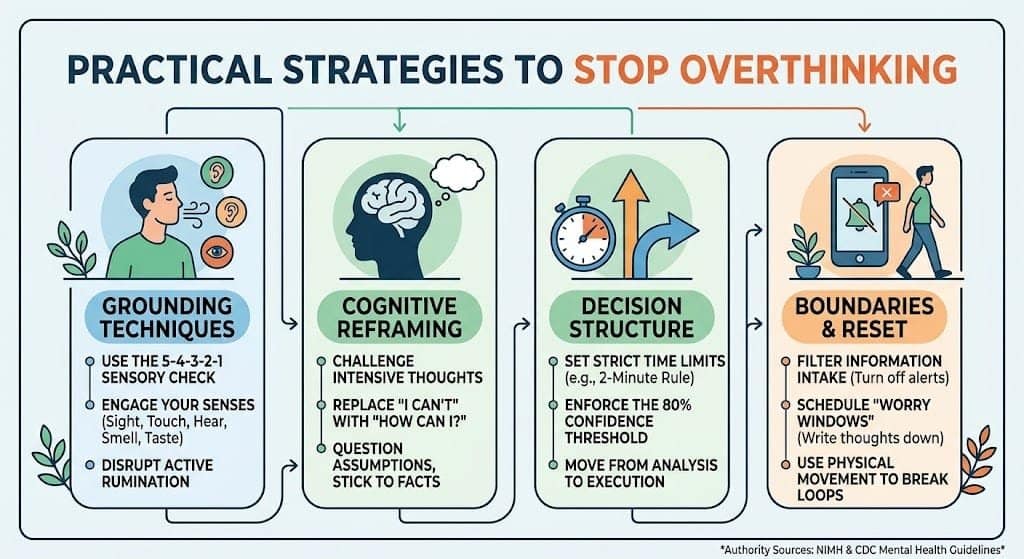
How to Implement Immediate Cognitive Reframing To Stop Overthinking
Recognizing cognitive distortions as they happen allows you to shift perspective in real time. Instead of accepting every intrusive thought as objective truth, practicing cognitive reframing teaches you to evaluate evidence and construct balanced, reality-based interpretations. This technique disrupts emotional reactivity and prevents minor stressors from spiraling into prolonged mental loops.
According to psychological resources from the NIMH Health Guidelines, cognitive reframing is a cornerstone of evidence-based therapy that directly reduces acute anxiety and disrupts chronic rumination.
- CDC Health Guidelines: Highlights mental flexibility and cognitive exercises as effective strategies for managing workplace stress and preventing burnout.
- Read our guide on building a simple self-care routine to learn how brief mindfulness breaks support long-term mental resilience.
Reframing Rule: When a worrying thought strikes, ask yourself: “Is this a proven fact or an unverified assumption?” If it lacks solid evidence, label it as a reaction rather than reality.
| Thought Process | Primary Characteristic | Emotional Outcome | Action Step |
| Rumination | Replaying past mistakes or open-ended worries | Exhaustion and anxiety | Pause and initiate a 5-minute physical reset |
| Problem-Solving | Focusing on controllable variables & answers | Clarity and closure | Draft a 3-step action plan or schedule a meeting |
Challenging the Validity of Intrusive Thoughts

Intrusive thoughts often carry an exaggerated sense of personal failure or catastrophic risk despite lacking objective evidence. When learning how to stop overthinking, pausing to evaluate whether a thought stems from verified facts or ungrounded assumptions strips the thought of its power. Simply labeling an intrusive narrative as “catastrophic thinking” shifts your stance from active participant to objective observer.
According to psychological insights from the NIMH Health Guidelines, actively questioning the accuracy of automatic negative thoughts reduces baseline anxiety and helps rewire emotional responses to stress.
- CDC Mental Health Resources: Recommends cognitive monitoring techniques to prevent workplace stress from escalating into chronic burnout.
- Read our guide on building a simple self-care routine to learn how daily mindfulness practices reinforce mental clarity.
Reality Check: Swap predictions for facts. Instead of telling yourself, “I am going to fail this project,” reframe it accurately: “I am feeling anxious about meeting this deadline, but I have a step-by-step plan to complete it.”
Practical Tips for Grounding Your Mind in Reality
When thoughts spiral, redirecting your focus toward immediate sensory input disrupts the cycle of rumination. Engaging your physical senses anchors your nervous system in the present moment, shifting focus away from abstract worries and future projections. Real-time physical sensations, environmental observations, and deliberate body movements serve as immediate touchpoints to restore mental clarity.
According to psychological guidelines from the NIMH Health Guidelines, sensory grounding practices directly reduce physiological arousal during acute stress spikes, making them essential tools when learning how to stop overthinking.
- CDC Mental Health Resources: Recommends incorporating brief physical resets throughout the workday to manage stress and prevent mental exhaustion.
- Read our guide on building a simple self-care routine to see how quick sensory breaks support daily emotional balance.
Grounding Rule: When your mind starts catastrophic projecting, immediately focus on three concrete objects in your room. Name their color, texture, and shape aloud to force your brain back to physical reality.
Utilizing the 5-4-3-2-1 Sensory Technique
The 5-4-3-2-1 technique forces your cognitive bandwidth to focus outward rather than inward. By systematically engaging each sense, you pull focus away from intrusive thoughts and anchor yourself in what is tangible right now:
- 5 Things You Can See: Notice subtle details, like light reflecting on a surface or wall textures.
- 4 Things You Can Touch: Feel the fabric of your clothes, the desk surface, or your feet firm on the floor.
- 3 Things You Can Hear: Tune into distant traffic, an air handler running, or outdoor birds.
- 2 Things You Can Smell: Focus on coffee brewing, fresh air, or essential oils.
- 1 Thing You Can Taste: Notice the lingering taste of mint, water, or a quiet breath.
Focusing on Physical Movement to Break Mental Cycles
Changing your physical posture or stepping away from your desk disrupts active thought loops. Physical movement introduces new proprioceptive input to the brain, signaling a transition out of a static, reflective state.
Postural Shifts: Standing up, stretching your shoulders, or splashing cold water on your face provides immediate sensory feedback that cuts through analysis paralysis..
2-Minute Walk: A quick walk to get water resets your environment and changes visual stimulus.
How to Streamline Your Decision-Making Process
Reducing mental fatigue requires establishing simple, predefined criteria for daily choices so you can execute without constant second-guessing. Implementing structured rules when learning how to stop overthinking protects your cognitive bandwidth, preventing minor daily decisions from consuming time better spent on high-priority goals.
According to workplace wellness guidelines from the CDC Mental Health Resources, reducing daily decision fatigue directly improves focus, lowers baseline stress, and prevents cognitive overload during high-demand projects.
- NIMH Health Resources: Explores how cognitive strategies and structured habits help curb analysis paralysis and emotional exhaustion.
- Read our guide on building a simple self-care routine to discover how daily boundaries support mental clarity.
Setting Time Constraints for Daily Choices

Enforcing strict time limits on low-stakes decisions—such as meal planning, outfit selection, or routine emails—prevents small choices from spiraling into prolonged internal debates.
- The 2-Minute Rule: For minor tasks, give yourself a maximum of 120 seconds to decide and execute.
- Pre-Set Defaults: Remove choice entirely by establishing daily routines or templates for recurring tasks.
| Approach | Focus | Real-World Outcome |
| Exhaustive Research | Seeking 100% certainty & avoiding mistake risk | Leads to analysis paralysis, delayed progress, and high fatigue |
| Action Thresholds | Enforcing “good-enough” data (80% confidence rule) | Produces immediate feedback, momentum, and fast course-correction |
The Role of Physical Health and Metabolic Stability
Poor sleep quality directly increases cognitive load, making it significantly harder for your brain to filter out irrelevant thoughts and emotional stress. Similarly, skipping meals or relying on heavily processed foods causes rapid blood sugar fluctuations that physically trigger adrenaline spikes and mimic anxiety symptoms. Establishing daily habits that support sleep hygiene and metabolic balance stabilizes your physical baseline, reducing the background physiological noise that fuels mental loops.
Metabolic Rule: Pair complex carbohydrates with healthy fats and lean protein during meals to prevent rapid blood sugar drops that mimic panic or intrusive overthinking.
Establishing Healthy Boundaries with Information Intake

Constant alerts, endless notifications, and habitual scrolling overload working memory, weakening emotional control and making it harder to stop overthinking. Information overload actively depletes cognitive bandwidth needed for calm, rational analysis. Reducing digital clutter lowers subconscious stress, frees up working memory, and restores decision-making quality.
Actionable Strategies to Reduce Digital Clutter
- Batching Communications: Designate specific 15-minute windows during the day to check email or social media rather than responding continuously in real time.
- Notification Filters: Turn off non-essential app alerts and push notifications to eliminate constant involuntary focus switches.
- Structured Silence: Build 10-minute “screen-free” buffers into your morning and evening routines to allow working memory to clear without external inputs.
Digital Boundary Rule: Never check news feeds or email within the first 30 minutes of waking up. Protecting your morning focus prevents high-arousal information from triggering overthinking loops before your day even starts.
Final Thoughts on Discrepancies and Mental Loops
Learning how to stop overthinking comes down to applying consistent cognitive filters, establishing firm decision timeframes, and testing intrusive thoughts against real-world evidence. Replacing passive rumination with immediate, deliberate action shifts your brain out of passive analysis and into execution mode. Mental clarity doesn’t come from controlling every outcome—it comes from building confidence in your ability to adapt as life unfolds.
CDC Health Guidelines: Highlights daily mental resets and structured downtime as core pillars of long-term psychological well-being.
NIMH Mental Health Resources: Outlines evidence-based cognitive strategies that lower chronic anxiety and prevent cognitive exhaustion.
Frequently Asked Questions
Q: How can I stop overthinking when lying in bed at night?
A: Nighttime overthinking often happens when your brain tries to process unresolved daily stress in a distraction-free environment. Schedule a dedicated 15-minute “worry window” earlier in the evening to write down active concerns alongside clear next steps. Externalizing these thoughts onto paper creates psychological closure, signaling to your mind that the problems are logged and ready to handle tomorrow.
Q: Can overthinking ever be productive, or is it always harmful?
A: Thoughtful analysis becomes harmful rumination when it loops continuously without producing concrete action. Constructive reflection is time-bound, structured, and focused on solutions. If you find yourself evaluating options without taking a step forward, set a strict 5-minute decision timer or enforce an “80% clarity rule” to move into active execution.
Q: What role does physical activity play in reducing overthinking?
A: Movement disrupts mental loops by shifting focus to physical sensations and altering neural chemistry. Activities like brisk walking, cycling, or light stretching trigger endorphins and lower cortisol levels. Even a 2-minute posture shift or short walk resets working memory, breaking the cycle of sedentary rumination.
